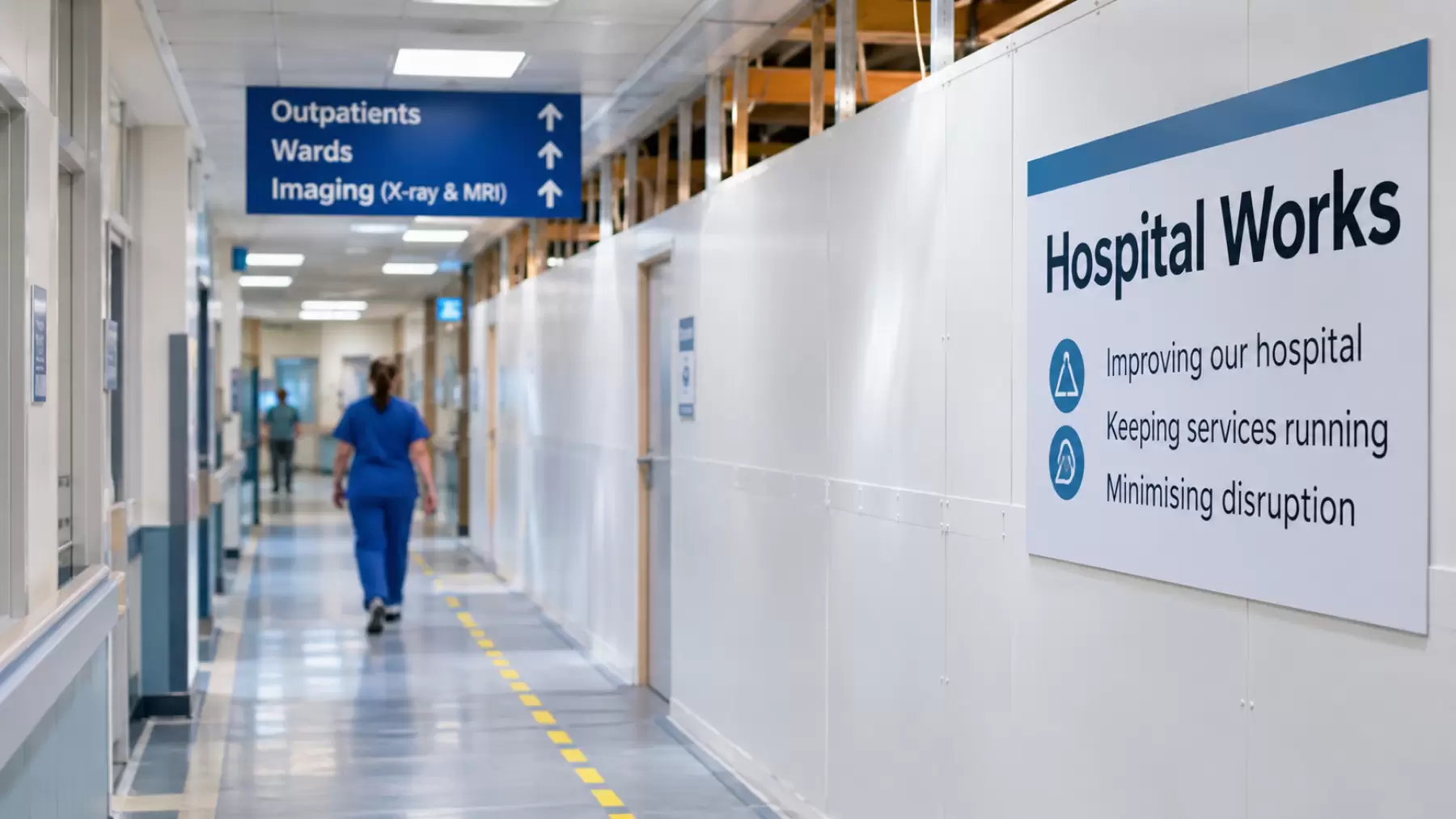
At Cliftons Projects, we have supported healthcare projects ranging from major new clinical facilities to refurbishments, specialist equipment installations and essential estate infrastructure. From that experience, there are several areas that consistently make the difference when delivering construction work within an operational healthcare environment.
Understand the Clinical Environment Before Developing the Programme
One of the earliest priorities should be understanding exactly how the affected areas of the hospital operate.
Who uses the space? Which departments depend on it? What services must remain available? Are there particular clinical periods when disruptive works cannot take place?
These questions should be answered before the construction programme becomes fixed.
A programme that works well from a purely construction perspective may be completely impractical operationally. Activities may need to be phased around clinical requirements, undertaken outside normal working hours or sequenced to maintain access to departments throughout the works.
Early engagement with clinical and estates teams allows these constraints to become part of the programme rather than problems that emerge during construction.
Plan Phasing and Decanting Early
On many healthcare projects, the ability to release space for construction is one of the biggest programme constraints.
Temporary accommodation, departmental moves and phased handovers can therefore become just as important as the construction activities themselves.
The project team should establish early:
which areas can be taken out of use;
which departments require temporary accommodation;
how patients and staff will access adjoining areas;
whether temporary clinical services are required; and
how each completed phase will be commissioned before the next area is released.
Trying to resolve these matters once a contractor is already on site can create significant delays and additional cost.
Treat Shutdowns as Projects in Their Own Right
Hospitals contain extensive electrical, mechanical, medical gas, IT and specialist systems, many of which cannot simply be switched off when construction work requires an interruption.
Any planned shutdown should therefore be carefully developed, reviewed and authorised.
The team needs to understand what systems will be affected, what services they support, whether temporary arrangements are required and what happens if the planned works cannot be completed within the agreed shutdown period.
Clear method statements, contingency arrangements and communication with affected departments are essential.
For critical infrastructure projects in particular, the consequences of an unplanned interruption can be considerably more significant than the construction activity itself.
Infection Prevention and Construction Must Work Together
Dust, noise, vibration and changes to airflow or access can all present additional risks in a healthcare environment.
Infection Prevention and Control requirements therefore need to influence the design, construction methodology and site logistics.
This could involve enhanced segregation, temporary partitions, negative pressure arrangements, controlled routes for contractors and materials, specialist cleaning regimes or restrictions on when particular activities can be carried out.
The important point is that these measures should not be treated as an addition immediately before construction starts. They should be considered during the design and planning stages so that appropriate allowances are included within the programme and budget.
Separate Construction Traffic From Hospital Operations
Moving workers, materials and waste through an occupied hospital requires careful planning.
Where possible, construction routes should be separated from clinical and public circulation. Delivery times may need to be controlled and temporary access arrangements established.
Escape routes must remain available and changes to circulation need to be clearly communicated.
On larger or phased projects, logistics plans should be regularly reviewed because the construction boundary and access requirements may change considerably as the works progress.
Allow Enough Time for Commissioning and Operational Readiness
Physical completion of the building work does not necessarily mean that a healthcare facility is ready to open.
New clinical spaces and specialist installations may require testing, commissioning, validation, staff training, equipment installation, cleaning and operational sign-off before patients can occupy the area.
These activities should appear within the main project programme rather than being treated as something that happens after construction.
The involvement of end users during design and commissioning also helps identify operational issues before they become expensive changes.
Communication Is Critical
Healthcare projects typically involve a particularly wide group of stakeholders.
Alongside the client, designers and contractor, this may include clinical departments, Estates and Facilities, Infection Prevention and Control, IT, medical physics, fire safety teams, specialist equipment suppliers and hospital management.
Each group may have different priorities, but construction decisions frequently affect several of them at the same time.
A clear governance and communication structure is therefore essential. Decisions need to be captured, responsibilities understood and issues escalated quickly when they could affect patient care, programme or cost.
Experience of Live Healthcare Environments Matters
Many of the challenges associated with healthcare construction are difficult to appreciate fully until they have been experienced in practice.
Cliftons Projects has supported the delivery of projects across NHS and healthcare environments including Chelsea Children’s Hospital, the Southampton Centre for Cancer Immunology, Dorset County Hospital and fast-track clinical facilities for Portsmouth Hospitals.
These projects have ranged from major clinical developments and research facilities to critical infrastructure and rapid capacity projects, often while adjoining hospital services remained operational.
The common requirement is careful coordination between construction delivery and the needs of the people who continue to use the building every day.
Plan Around the Hospital, Not Just the Construction
Ultimately, the most successful healthcare projects are those where construction is planned around the operational needs of the hospital rather than expecting the hospital to accommodate the construction programme.
Early stakeholder engagement, realistic phasing, carefully managed shutdowns, appropriate infection-control measures and robust commissioning planning can significantly reduce risk.
For healthcare clients, appointing an experienced client-side project team early can help ensure these requirements are identified before they affect programme, cost or clinical operations.
Cliftons Projects provides Project Management, Client Representative, Cost Consultancy, Contract Administration, programme and procurement support for healthcare projects across Hampshire, the South Coast, London and throughout the UK.
For more information on Cliftons Projects and our work across the healthcare sector, please email us at info@cliftons-projects.com